Let’s be entirely real for a second: the Indian festive shopping season isn’t just a sale anymore. It is an algorithmic, highly competitive digital sport.
Every year, millions of shoppers log into e-commerce platforms hoping to score the ultimate tech flex: a flagship Apple iPhone. And this year, the stakes are higher than ever.
With the highly anticipated iPhone 18 hitting the market and establishing itself as the new undisputed heavyweight champion of Apple’s premium lineup, the pricing dynamics for older generations have completely shifted.
Because the iPhone 18 is currently dominating the spotlight, Flipkart is weaponizing its Big Billion Days (BBD) 2026 sale to aggressively liquidate its massive inventory of iPhone 17, iPhone 16, and iPhone 15 units.
Right now, if you log onto Flipkart, the iPhone 16 is sitting pretty at a listed price of ₹69,900. But make no mistake: that is not the Big Billion Days sale price. That is the psychological anchor price meant to make the upcoming discounts look absolutely insane.
This article is your ultimate playbook for BBD 2026. We are going to unpack the exact math behind the deals, expose the hidden banking caps, and give you a foolproof, step-by-step checklist.
Grab a coffee. Let’s decode the algorithms.
The Timeline: When Does the Chaos Actually Start?
If you wait until you see an ad on TV to start shopping, you’ve already lost. The Big Billion Days sale operates on a strict, tiered access hierarchy designed to reward platform loyalty and generate intense FOMO (Fear Of Missing Out).
Here is the exact schedule you need to burn into your calendar:
- The Early Access Window: Starts exactly at Midnight (12:00 AM) on October 8, 2026.
- The General Public Sale: Opens at Midnight (12:00 AM) on October 9, 2026.
Why Early Access is Non-Negotiable
If you are aiming for a highly discounted iPhone 15 or iPhone 17, the Early Access window is not just a perk; it is a mandatory requirement.
Flipkart Plus, Flipkart VIP, and Flipkart Black tier members, along with eligible co-branded credit card holders, get a 24-hour head start.
By the time the clock strikes midnight on October 9 for regular users, dynamic pricing algorithms have usually kicked in. The initial stock of rock-bottom iPhones evaporates, and the platform quietly raises the price by ₹3,000 to ₹5,000 based on demand velocity.
Pro Tip: If you aren’t a Plus or Black member, find a friend who is. You want to be checking out at 12:01 AM on October 8.
The iPhone Price Drop: Decoding the Real Numbers
Flipkart loves to use massive banners with “Effective Prices.” But what does an “effective price” actually mean? It means the price you see on the poster is only achievable if you jump through several financial hoops.
Let’s break down the exact pricing architecture for the star players of the 2026 sale.
The Headliner: iPhone 17 (256GB)

The iPhone 17, sporting the powerful A19 chip and that gorgeous 6.3-inch display, is the absolute poster child of this year’s sale. Flipkart teased it heavily with an “under ₹80,000” banner.
- Current Listed MRP: ₹99,900.
- The “Teased” Sale Price: ₹79,999.
- Total Marketed Discount: ₹19,901.
But here is the catch. You don’t just add it to your cart and pay ₹79,999. To get that exact price, you need a perfect storm of financial stacking:
- The Base Discount: The platform drops the base price to around ₹82,900 to ₹84,999.
- The Credit Card Bonus: You must use an Axis or ICICI Credit Card transaction to unlock a flat ₹2,500 discount.
- The Exchange Bonus: You must trade in an eligible older device to get a flat ₹3,000 exchange bonus applied on top of the old phone’s value.
If you manage to use a Flipkart Axis Bank or SBI credit card, you might squeeze out an extra 5% cashback, bringing the net effective hit to your wallet down to an incredible ₹77,999.
The Volume King: iPhone 16
While the iPhone 17 gets the billboard space, the iPhone 16 is what can actually break the internet. As noted, the iPhone 16 (128GB) is currently sitting at ₹69,900 on the platform, which is just the pre-sale resting price.
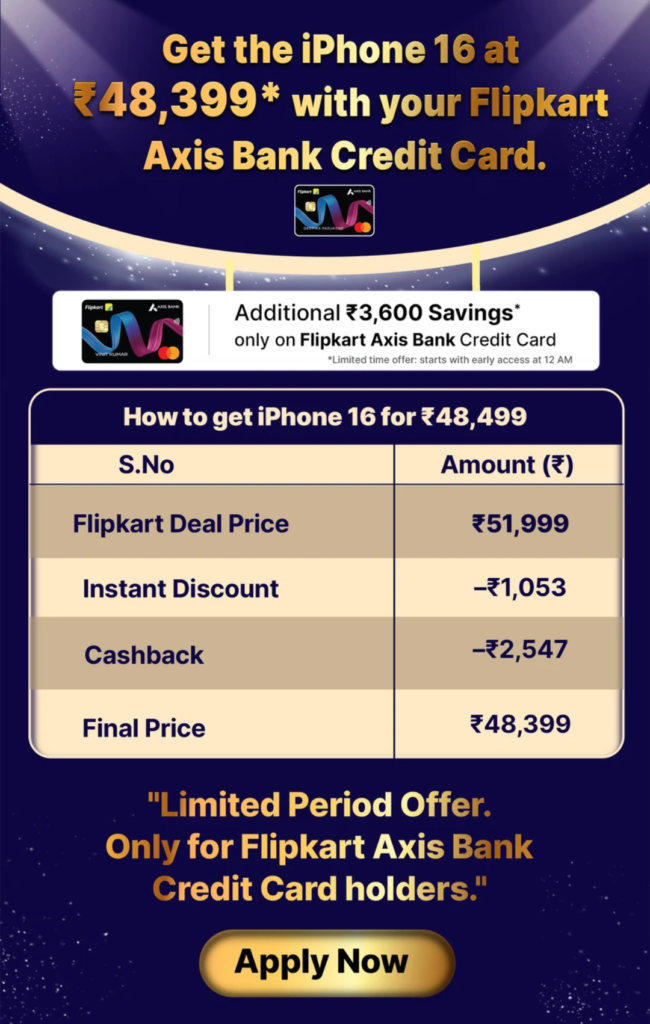
During the Big Billion Days Early Access rush, this model is expected to plummet to an astonishing ₹51,999.
This represents an almost ₹18,000 price slash from the current market rate, making it the most aggressive value proposition in the entire Apple lineup (if it happens). This is the model that can go “Out of Stock” within the first 10 minutes.
The Budget Entry: iPhone 15 & 14

For those who just want the Apple ecosystem without bleeding their savings account dry, the older A16 Bionic models will be heavily discounted.
- The iPhone 15 (128GB), usually retailing around ₹74,900, will drop to a starting effective price of ₹63,999 (inclusive of bank discounts).
- The iPhone 14 is expected to crash down to ₹39,999, serving as the ultimate aggressive entry-level device.
📊 The Master BBD 2026 iPhone Pricing Table
Here is your quick-reference cheat sheet for the expected iPhone lineup.
| Apple Model & Variant | Pre-Sale Listed Price | BBD 2026 Target Price | Key Requirements to Unlock Price |
| iPhone 17 (256GB) | ₹99,900 | ₹77,999 | CC + Exchange Bonus |
| iPhone 17 Pro | ₹1,34,900 | ₹1,18,000 – ₹1,28,000 (expected) | Bank Discount + Exchange |
| iPhone 17 Pro Max | ₹1,47,900 | ₹1,20,000 – ₹1,30,000 (expected) | Bank Discount + Exchange |
| iPhone 16 (128GB) | ₹69,900 | ₹51,999 (expected) | Eligible Bank Card Required |
| iPhone 16 Plus | ₹84,900 | ₹84,900 (Expected lower) | Dynamic Pricing applies |
| iPhone 16 Pro | – | ₹69,999 (expected) | High Flight Risk (OOS Fast) |
| iPhone 16 Pro Max | ₹1,44,900 | ₹89,999 (expected) | High Flight Risk (OOS Fast) |
| iPhone 15 (128GB) | ₹74,900 | ₹63,999 | Eligible Bank Card Required |
| iPhone 14 | – | ₹39,999 (expected) | Base model entry price |
| iPhone 13 Mini | ₹69,900 | ₹64,900 (expected) | 7% Base Off + Cards |
Note: Prices marked “Target” include the stacking of available card discounts and exchange bonuses. Naked cart prices will be slightly higher.
Beyond the iPhone: Ecosystem Deals You Shouldn’t Ignore
While iPhones steal the limelight, Flipkart uses BBD to aggressively push the wider Apple and premium tech ecosystem. If you are already upgrading your phone, the algorithms are going to tempt you with ecosystem bundles.
The MacBooks and Watches:
- Apple MacBook Air M1 (2020): Still kicking as one of the best value laptops on earth, the 8GB/256GB model is expected to get good price cuts during the sale.
- Apple Watch Series 12: The latest wearable
- Samsung Galaxy Watch 9: For Android users (perhaps picking up the heavily discounted Galaxy S25 or S25 FE), the 40mm Watch 9 can start aggressively below ₹37,999, scaling below ₹41,999 for the LTE 44mm version.
The Audio Flex: Beats 360 If you want to step outside the standard AirPods ecosystem, keep an eye out for the newly launched Beats 360 over-ear headphones.
- These flagship cans feature Apple’s most advanced Active Noise Cancelling, custom drivers, and an IPX4 sweat/water resistance rating.
- They just hit shelves in September 2026, so while deep BBD discounts on them might be rare, standard bank card cashbacks will absolutely apply.
The “10% Bank Discount” Illusion (Read the Fine Print)
Flipkart splashes “10% Instant Discount via Axis, ICICI, and SBI Cards” all over their homepage.
Let’s do some quick math. 10% of a ₹79,999 iPhone 17 is essentially ₹8,000, right? Wrong.
That is not how e-commerce financial engineering works. The banks protect their margins by utilizing strict capping limits on every single transaction.
How the Caps Actually Work
- Non-EMI Full Swipes: If you pay the full amount upfront using your credit or debit card, the 10% discount is usually capped at a hard limit: often just ₹1,000 to ₹1,500 per card.
- Credit Card EMIs: Banks want you in debt. They make money on processing fees and potential interest. Therefore, they incentivize EMI transactions. If you choose a 6-month or 9-month EMI plan, the discount cap is usually raised to ₹2,000 or ₹2,500.
So, when calculating your budget, do not subtract 10% from the phone’s price. Subtract ₹1,500. It is a massive difference that catches millions of shoppers off-guard at the checkout page.
Note: iPhones are exceptions here because they have higher cap (on or above ₹2,500 for iPhone 17 and iPhone 15)
The Dark Side: Order Cancellations and “Lost In Transit” (BBD 2025)
The sheer volume of traffic during Big Billion Days pushes Flipkart’s logistics arm (Ekart) to the absolute breaking point. And unfortunately, the consumer often pays the price.
A massive controversy erupted out of last year’s BBD sale involving the mysterious cancellation of highly discounted orders.
The “Bait and Switch” Phenomenon: Picture this: You stay up till 12:00 AM. You fight the lagging servers. You successfully buy the iPhone 16 for ₹51,999. Your credit card is charged. You celebrate.
3 days later, the tracking status changes to “Lost in Transit” or “Cancelled due to unforeseen circumstances.
Flipkart automatically initiates a refund. But here is the infuriating part: Flipkart customer service will tell you to just “reorder the item.” But when you go to reorder it, the dynamic pricing algorithms have kicked in, and the iPhone 16 is now sitting at ₹62,000.
Users across X (Twitter) and Reddit called this a blatant bait-and-switch scam. The platform secures your liquid cash for a few days, boosts their GMV metrics for investors, cancels the loss-leader sale, and then expects you to buy it at a higher price.
If this happens to you, there isn’t much recourse other than taking to social media to publicly shame the support handles, which occasionally forces them to honor the original price, but it is a grueling battle.
The AI Revolution: How Buyers are Fighting Back
It isn’t just the platform using algorithms anymore; the buyers are fighting back with artificial intelligence.
The e-commerce landscape is shifting. According to a recent report by InMobi and NIQ Insight, a staggering 92% of surveyed urban Indian shoppers have utilized at least 1 AI tool for shopping in the past month.
During this BBD, 4 out of 5 shoppers are expected to actively deploy AI-powered shopping assistants. What are they doing with it?
- Tracking algorithmic price drops across Flipkart and Amazon minute-by-minute.
- Instantly calculating the optimal math for stacking SuperCoins, bank cards, and EMI cashbacks.
- Using generative AI to summarize complex Terms and Conditions for things like the Price Lock Pass.
Interestingly, it isn’t Gen Z leading this charge. The data shows that Millennials are actually out-pacing Gen Z by 10 percentage points in their enthusiasm for using AI to hack the festive sale matrix.
They have the disposable income, and now they have the tech to beat the system.
Side note: This heavy investment in AI mirrors broader global trends, such as the Bill Gates Foundation’s recent $400 million push to integrate adaptive AI into education systems. The tech is fundamentally reshaping how we learn and how we spend.
The Final Verdict
The Flipkart Big Billion Days 2026 is undoubtedly the best time of the year to buy an iPhone in India. The sheer scale of the discounts: pulling an iPhone 17 down to ₹77,999 or an iPhone 16 to a ludicrous ₹51,999, is unmatched in the global tech retail space.
But you have to treat this sale like a tactical operation, not a casual shopping spree.
The deals are real, but the friction is immense. Load your credit cards, set your alarms for 11:55 PM on October 7th, and may the algorithms be ever in your favor. Happy hunting.